 pipmoth
How it’s made
Stitching both sides in Backstitch
September 2026
My mom is a quilter. While I was making Backstitch I asked her a lot about how closely it matched real sewing. She has been working through the puzzles and finds them pretty hard. She likes doing them while watching Survivor.
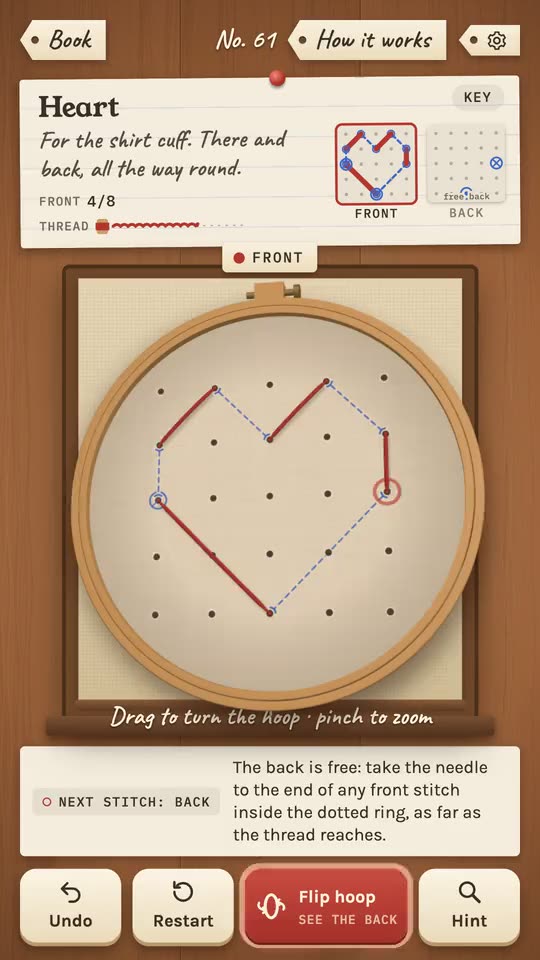
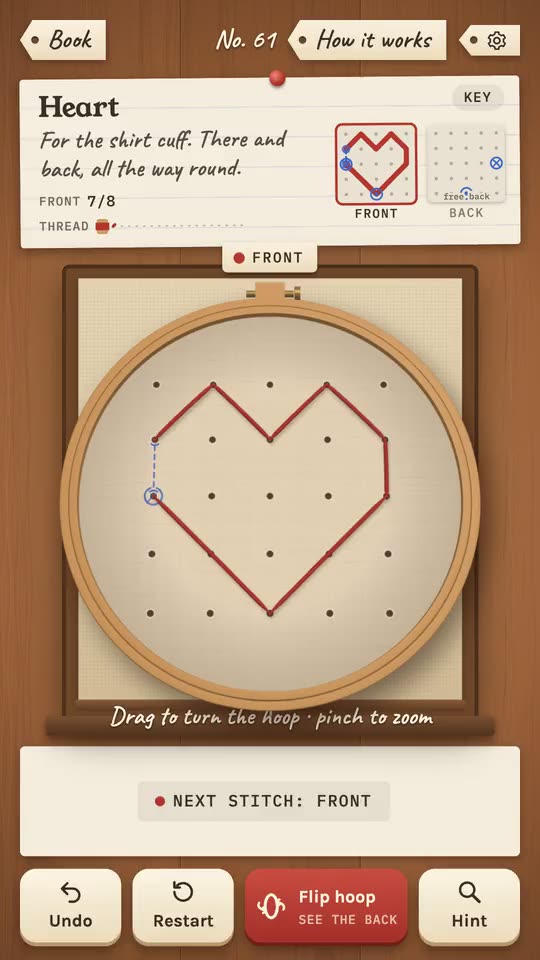
In Backstitch, every tap passes the needle through the cloth. A stitch on the front is followed by a stitch on the back, then the front again. A pattern is finished only when both sides match.
That rule belongs to the thread. Nothing about it had to be invented.
The trouble with the first version
An early design review listed what was weak. At the top was that you often couldn’t tell what a pattern wanted. Every stitch was drawn as the same dashed line with a ring at each end, so stitches in a row ran together. One back pattern looked exactly like three short stitches.
So the way stitches are drawn was reworked.
Tracing or thinking
The second problem was the puzzle. Early patterns had between 2 and 40 solutions, and the review said they played “more like tracing than thinking”. A good pattern needs fewer answers, and routes that look right until three stitches later.
So the game has a solver. It counts the ways through a pattern, finds the traps, and works out how deep each one goes before you are stuck.
What the solver found
It also corrected an idea. The plan was to teach players to count what was left partway through a pattern. A check of 62 patterns and 116,131 positions showed that with one thread, that count never changes along the way. The hint could only ever repeat what a wrong start had already told you. The lesson moved to a later chapter, where a second thread makes it true.
The other side
You can turn the hoop over whenever you like. The back is half the pattern.
Liam